Beginner piano lessons connect listening, rhythm, finding notes, comfortable movement and simple musical phrases. These skills develop together; reading, using both hands and playing expressively are not boxes everyone completes on the same timetable. Ask for a clear next task rather than a promise to finish a song by a particular date.
Start with a musical task, not a deadline
A beginner may arrive hoping to play a favourite song with both hands. That is a useful goal, but the first steps may look smaller: recognising a group of keys, repeating a rhythm or playing a short phrase with an even pulse. Those activities help connect the instrument’s layout with what you hear.
Ask the teacher to explain how the activity relates to your goal. “We are practising this change because it appears in your melody” is more helpful than an exercise with no explanation. For a child, ask what you should listen for at home rather than measuring the lesson by the number of pages covered.
The building blocks below can overlap. Your teacher will choose the starting task and pace with you. Explore piano lessons at DSM and discuss your goals with the school.
Get comfortable with the instrument and its layout
Early work includes finding your place at the keyboard and moving without repeatedly repositioning yourself. Yamaha’s piano guide explains the relationship between seating height, the keyboard and relaxed movement. Ask your teacher to check the setup on the instrument you use, particularly for a growing child.
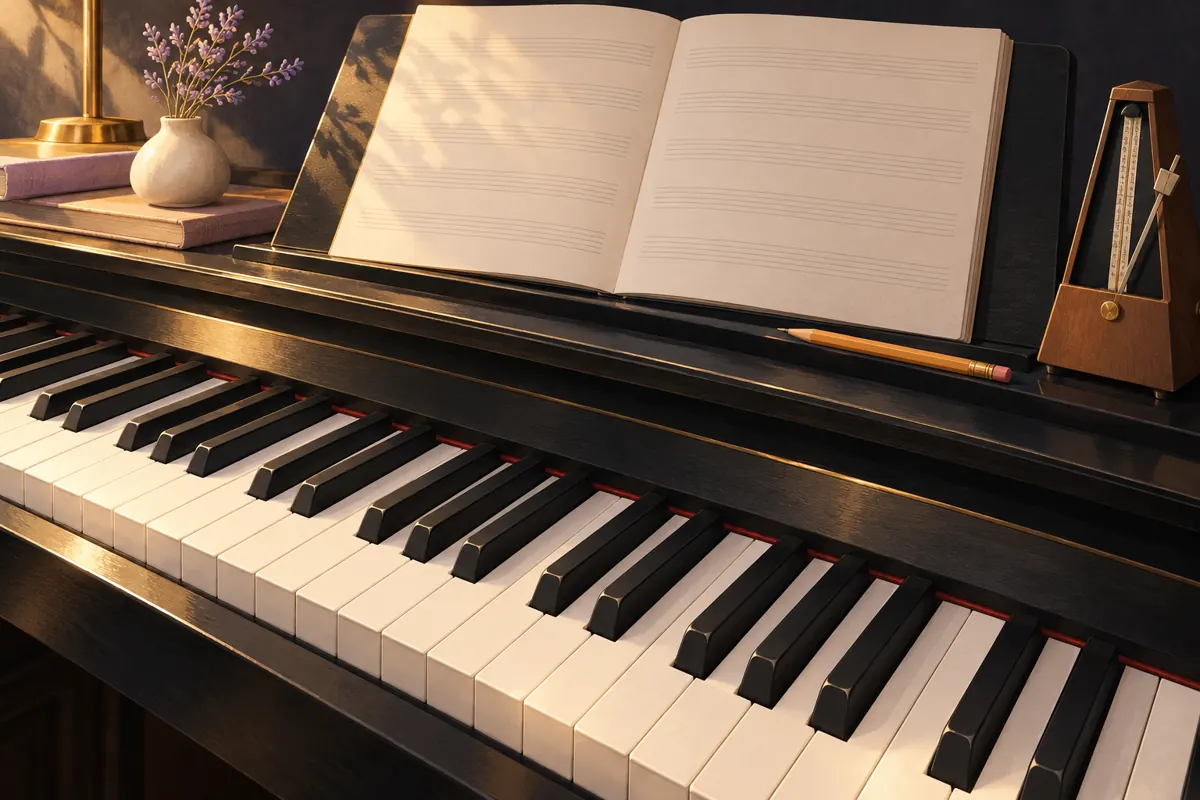
The repeating groups of two and three black keys provide visual landmarks. A teacher can use those landmarks to help you find notes rather than memorising the entire keyboard as one long sequence. Finger numbers and note names then become practical instructions: which finger, which key and where to move next.
For home practice, share the model of any instrument you already own. If you are still choosing equipment, our piano-versus-keyboard guide covers the differences without assuming that every keyboard suits every piano task.
Connect notes and rhythm to something you can hear
Reading music means more than naming a note. You also need to work out when it starts and how long it lasts. A teacher might separate those jobs: first clap or count a short rhythm, then find the notes, then bring them together. The order can change to suit the learner.
Consider a short phrase you can already recognise by ear. Can you hear whether your version has the same rhythm? Can you keep the pulse moving through a rest? Questions like these turn reading into a musical activity rather than a speed test.
Letters written above every note can feel useful at first, but ask the teacher how any support should be used and reduced over time. The goal is to understand the pattern you are playing, not to rely permanently on an extra set of labels.
Build hand coordination in manageable pieces
Playing hands separately and playing them together are related but different tasks. A melody may be comfortable on its own while the accompaniment still needs attention. Putting them together more slowly, or using a shorter section, gives you a clearer problem to solve than repeatedly starting the entire piece again.
- FindLocate the starting notes and understand the movement.
- Read and hearConnect the written rhythm with a recognisable phrase.
- CoordinateBring parts together at a manageable pace.
- ShapeListen to how the phrase begins, changes and ends.
This map is not a sequence of grades or a fixed lesson schedule. A learner can return to the same four questions as the music becomes more demanding. Ask your teacher which small section to work on and how to know when it is ready to expand.
Notice progress beyond finishing a piece
| What you notice | What to discuss next |
|---|---|
| Starting notes are easier to find | Can the learner begin from another short section too? |
| The rhythm continues through a tricky place | Is the pace manageable, or does that section still need separating? |
| The learner notices a different note or rhythm | Can they describe it and try a correction? |
| A phrase has an intentional ending | What changes in touch or timing help it communicate? |
These are conversation prompts, not a test or a promise of progress after a set number of lessons. Keep a short note of the teacher’s feedback and compare the learner with their own previous attempt. A longer or faster piece is not automatically evidence of better understanding.
For parents, one useful question is, “What did the teacher ask you to listen for?” If the child cannot explain, ask the teacher to demonstrate the home task. You do not need to turn into a second piano teacher.
Leave the lesson knowing what to do at home
A good practice instruction identifies a task, a section and something to notice. “Work on the first short phrase and keep the pulse through the rest” gives a beginner more direction than “Practise your piano.” The exact material and pace should come from the teacher.
Bring questions to the next lesson: where did the hands stop agreeing, which symbol was unclear, or why did the practice instrument sound different? If you want to record a short practice clip for feedback, ask the teacher about the preferred method rather than posting a child’s video publicly.
Before joining, confirm the available batch, home equipment and weekly commitment. You can prepare for a free trial and discuss the course at Dwarka Sector 7 or Dwarka Sector 22. A useful first outcome is knowing the next manageable step.
Common questions
How long until I can play with both hands?
There is no single timetable. The difficulty of the material, your starting point and how you practise all matter. Ask for a short coordination task and feedback on that task instead of a fixed completion date.
Do I need to read music before my first lesson?
No prior reading is needed to enquire about beginner lessons. Tell the team about any musical experience, and ask how reading, rhythm and listening will be introduced.
Can adults use the same beginner building blocks?
Yes. Finding notes, rhythm, coordination and expression are relevant to adult beginners too. The pace, examples and repertoire should reflect the learner’s goals.
MAKE YOUR NEXT STEP CLEAR
Talk through your starting point.
Tell us what you want to learn and which branch suits you. The school will confirm the available class, current fees and a trial time.