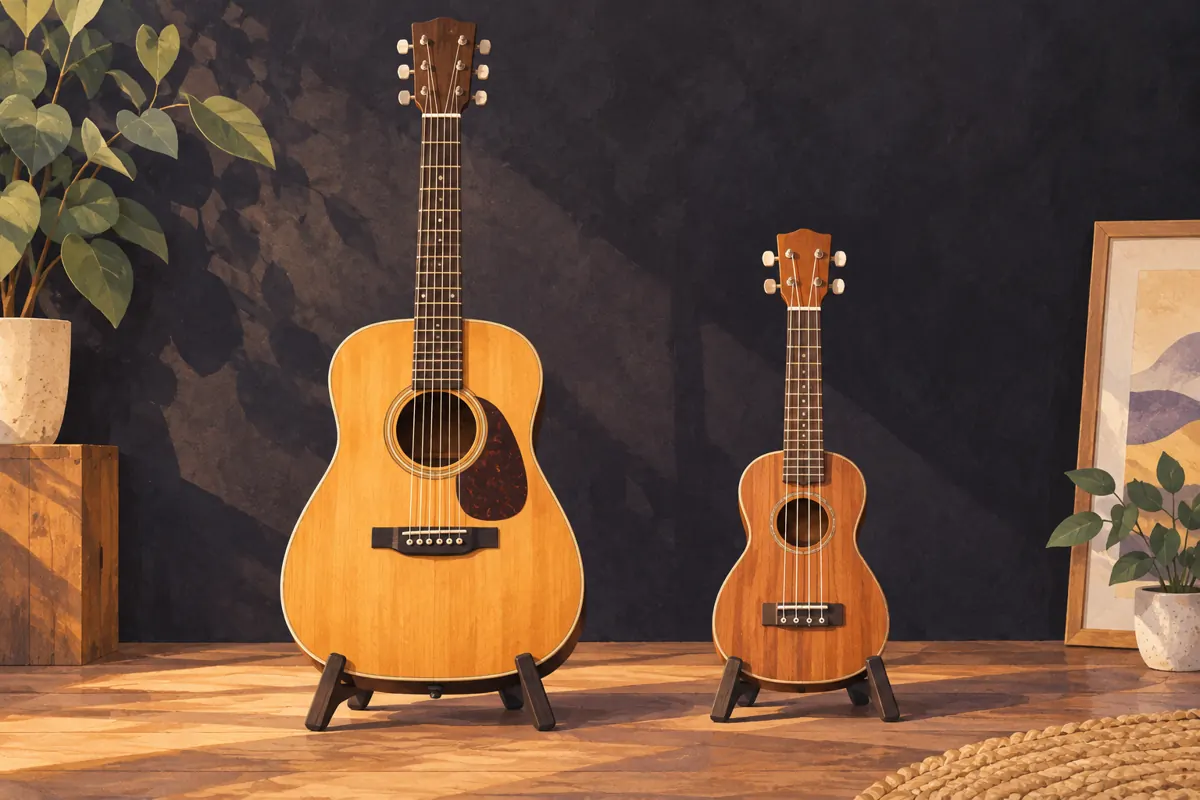
Choose the sound your child wants to explore, then check the fit and a simple playing task with a teacher. A ukulele’s compact body may suit some learners, while a suitable guitar may better match another child’s interest. Fewer strings or a smaller body does not make one instrument the right answer for everyone.
Start by listening together
Ask your child to choose a song or performance they enjoy. Then listen for the part that attracts them: the strummed chords, a picked melody, an amplified riff or a voice with accompaniment. The answer helps you understand the musical interest behind the instrument request.
Do not choose ukulele only as a compulsory step towards guitar. It is an instrument with its own repertoire and possibilities. Equally, a child who likes guitar does not need to abandon that interest because someone describes ukulele as easier. A suitable beginner task and instrument fit are more informative than the label.
If the guitar sound they enjoy is electric, discuss that directly. Our acoustic-or-electric guide explains why acoustic guitar is not a mandatory first stage.
Understand the practical differences
A standard six-string guitar and a typical four-string ukulele differ in their tuning, feel and available range. Common soprano, concert and tenor ukuleles are not all the same size; baritone models also introduce different tuning considerations. Ask the teacher which type they would use before buying. Fender’s beginner buying guide explains ukulele sizes and equipment choices.
| Question | Guitar | Ukulele |
|---|---|---|
| Usual string count | Six on a standard guitar | Four on a typical ukulele |
| What should you try? | Body size, neck reach and the chosen string/setup combination | Body size, neck spacing and the particular ukulele size |
| Musical interests to discuss | Accompaniment, fingerpicking, riffs or lead playing | Strummed songs, singing along, fingerpicking or melody |
| Home decision | Appropriate instrument, storage, tuning and any amplification | Appropriate size, storage, tuning and any accessories |
These are common starting configurations, not a rule covering every instrument. The illustration above is not a sizing chart.
Check comfort on a real instrument
Ask the teacher to watch your child hold and try the actual instrument. Can it be supported without constant adjustments? Can they reach the intended playing position comfortably? If the setup is awkward, try another size or model before deciding that the child is too young for that instrument.
Yamaha’s first-guitar guide explains why body dimensions, reach and setup affect playability. A fractional-size label alone cannot tell you whether a particular guitar is right for your child. Ask for a practical fit check rather than buying an instrument they are expected to grow into.
Do not force a hand position or ask the child to keep playing through discomfort. Explain what feels awkward to the teacher so the instrument and task can be reconsidered. A short fit check can make the next decision much clearer.
Compare a small task rather than an entire song
If both instruments are available, ask for a short introduction on each. The tasks do not have to be identical: a comfortable single-note pattern, a simple chord or a steady strum can reveal something about the experience. The teacher should choose the task and explain how to try it.
- ListenWhich sound does the child want to hear again?
- HoldWhich actual instrument can be supported comfortably?
- TryCan the explanation become a small, repeatable action?
- ReflectWhich task makes the child curious to try again?
Do not turn the comparison into a race. An unfamiliar task may need a second explanation, and an instantly satisfying sound does not tell you everything about the course. Combine the child’s response with the teacher’s guidance and the family’s practical circumstances.
Plan the setup and the whole cost
Request a specific equipment list after the fit discussion. Include a suitable instrument, a tuning method, protective storage and any items required for the chosen course. For an electric guitar pathway, discuss the cable and an appropriate amplifier or headphone setup as well. Do not assume every amplifier accepts headphones.
Ukulele strings and guitar strings should not be treated as interchangeable. Fender’s equipment guide recommends matching ukulele strings to the instrument type. For either instrument, ask a qualified retailer or teacher about changes rather than experimenting with unsuitable strings.
Compare total setup cost and current lesson fees separately. A low advertised instrument price is not a complete learning budget, and prices or retailer bundles change. Ask DSM for the current course fees and available batches before planning your monthly budget.
Choose a starting point, then keep listening
Once you have chosen, agree a small first learning goal and ask what practice will look like at home. Give the course a clear purpose that your child can understand, such as learning an accompaniment pattern for a song they enjoy, rather than a promise to become advanced quickly.
Some listening and rhythm experience can remain useful if interests change later, but guitar and ukulele have different tuning and fingerings. Changing instrument still involves learning; it is not an automatic transfer of every chord or technique.
Explore DSM’s acoustic guitar, electric guitar and ukulele pathways, then ask about a suitable free trial. If your main question is whether to start lessons at all, our readiness guide for parents helps you prepare that conversation.
Common questions
Is ukulele always easier than guitar for children?
No instrument is the best fit for every child. String count and size are only part of the decision. Compare the sound, actual fit, teaching task and home routine with a teacher.
Will a small ukulele be suitable for every young child?
Not necessarily. Ukuleles vary in size and neck feel, and the teaching approach matters too. Try the actual model with guidance instead of choosing only by age or appearance.
Does learning ukulele mean my child can already play guitar?
Some listening, rhythm and practice habits can be useful, but tuning, fingerings and technique differ. Expect to learn the new instrument rather than assume every shape transfers.
MAKE YOUR NEXT STEP CLEAR
Talk through your starting point.
Tell us what you want to learn and which branch suits you. The school will confirm the available class, current fees and a trial time.